
It’s generally a good idea to disregard all unsolicited survey and giveaway emails.
At best, they are from a legitimate business, using an email address you provided to them. Their end goal is to sell you stuff – which you probably don’t really need.
At worst, they are from scammers, using an email address they stole or bought. Their end goal is to steal your identity and/or your money – which you definitely don’t need.
Here are the eight reasons I categorize this particular email as a probable scam:
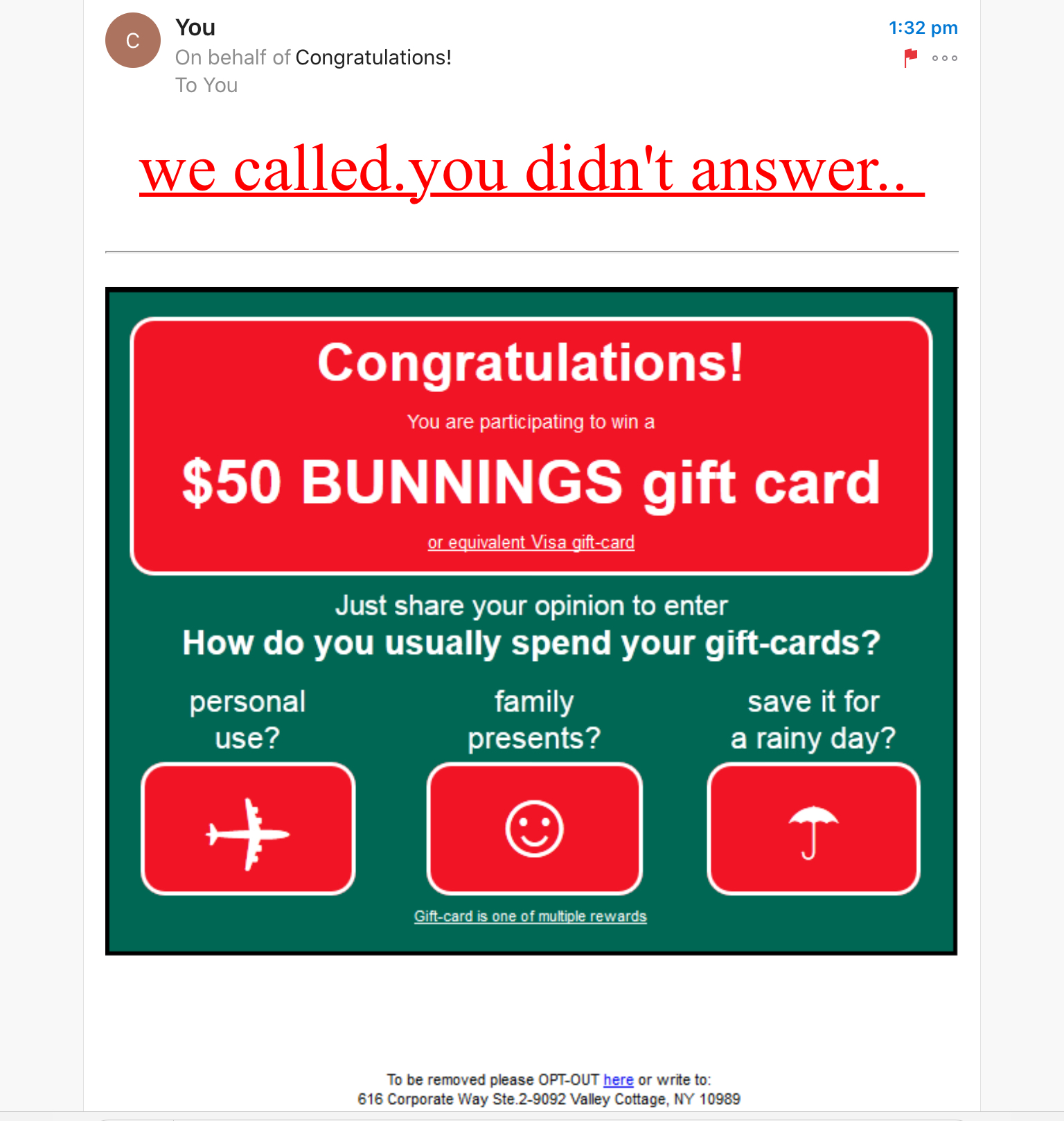
 1) The sender is not anyone I recognize. Who is “Congratulations!”? Despite using Bunnings’ name and approximate colors, the font is wrong and the logo is missing.
2) It is not addressed to me. If I had signed up to a mailing list, the sender would have used my first name.
3) The text is not written properly. There are no capital letters, no space between sentences, and it’s not normal to use two periods in a row. Real businesses pay far greater attention to their marketing copy.
4) The text is a hyperlink. In this context, that’s very suspicious. Where would the hyperlink go to? It doesn’t make sense.
5) No they didn’t call me.
6) They don’t even make it clear what the email is about. Congratulating me for a prize even though I haven’t entered yet?
- The aim, of course, is to make readers think they will receive the prize if they click one of the hyperlinked survey options.
- In almost every case of an email like this, the entire image is one single hyperlink. It makes no difference which survey option you click, and the result will be the same – because there is no survey, and everywhere you click takes you to the same webpage.
You can test this out for yourself by viewing an email like this on a laptop or desktop computer. Hold your mouse over different parts of the image, and you will see that the mouse pointer remains a ‘hand’ at all times. If you can see the destination URL, you will see that it doesn’t change when you shift the mouse from one ‘button’ to another. - You will usually be redirected to a website, where you are required to enter your details so that the gift card can be mailed to you. The scam website might even want your bank details so they can deposit straight into your account.
No gift card or cash prize will be sent to you. Instead, the scammer will use your information to steal your money or your identity; or they will use the information for a bigger/different scam; or they will sell your information to another scammer.
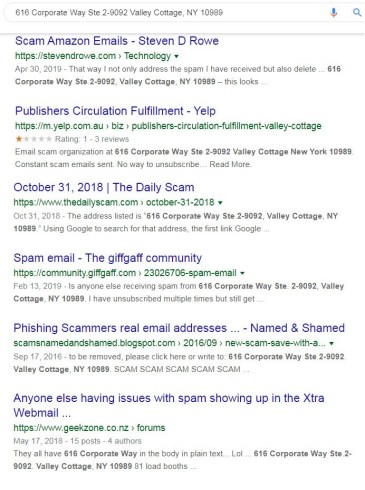
7) The sender’s physical address, at the bottom of the email, doesn’t make sense either. Bunnings is an Australian business, with stores here and in New Zealand. Why on earth would they send out emails from USA?
Bunnings would have put its own address and branding on the email, so we can be certain it wasn’t from them. So who is at that particular address?
A quick Google search doesn’t identify any specific business, but it is possible that a real email distribution business operates there. In any case, the top search results suggest an untrustworthy reputation.

8) Bunnings is a very popular store, and images of its gift cards are used for giveaway scams so often that the company has a warning on its website at https://www.bunnings.com.au/scam-warning.
Scammers use colours and images of businesses we are familiar with to trick us into trusting their message, and to increase the probability that we will click on their links.
The images frequently contain an extra element of nasty: A special pixel which is coded to let the sender know you have opened the email. This is what email accounts are referring to when they state that “images have not been downloaded to protect your privacy”, or words to that effect.
Legitimate businesses use pixels so they can gather statistics about their marketing emails, and zero in on those who open and/or respond to emails. Scammers use them for the same purpose.
Anyway, there are many different versions of the survey/giveaway email scam. They (mis)represent different types of businesses and prizes, but what they have in common is a lot of images and hyperlinks. You will often see that the entire email, including all text, is just one hyperlinked picture. Do NOT click on it.
Do NOT click on an Unsubscribe or Opt Out hyperlink either.
Do not click on anything.
Instead, the safest way to deal with emails like this is to mark them as junk so you won’t see any more, and then delete the current one. You might also consider setting your email account to not download pictures without your specific approval.
Until next time, stay safe online 🙂

 That Scam Show