
In November, 7 people were arrested in America, as law enforcement authorities searched for three more, charged with money laundering in an international romance scam operation. Three months earlier, ‘Dozens of Nigerian nationals arrested in California over alleged $68m love scam‘.
What’s the connection between romance scams and money laundering?
To understand that, we need to consider that romance scammers are not always some young kid sitting in Nigeria, hunched over a laptop or phone.
Romance scams are often operated by groups. Let’s call them crime rings, because that’s what they are. A dude operating by himself is likely to settle for a gift card, but if scammers want to level up to the big bucks and/or to appear more convincing by having ‘local’ (USA) bank accounts, they have to cooperate with people who can open and access those accounts: People with access to fake or stolen identities, or local residents who are tricked into becoming money mules.
One very important thing that I’d like to point out is that it’s not only elderly people who are targeted for romance scams. The following chart shows statistics about romance scams reported in Australia during 2019. You can see that all age groups are targeted, and all age groups experienced some level of financial loss.
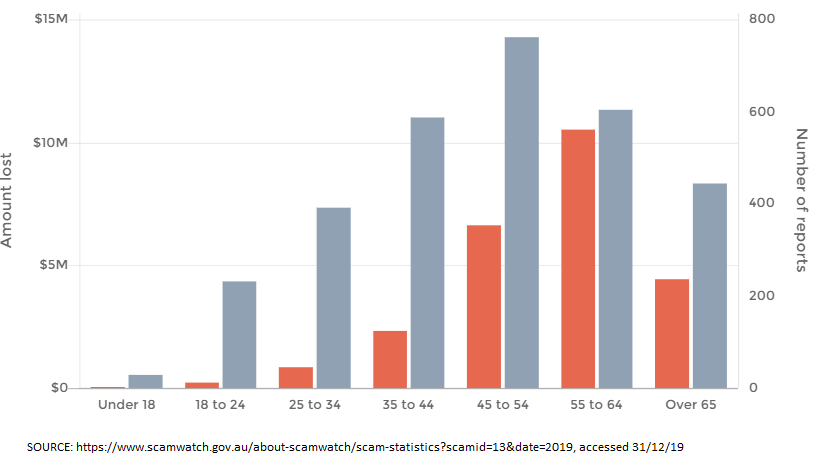
Men and women over 40 are especially targeted, and in the early stages of a chat with a scammer, they will usually ask questions to determine this. The reason, apparently, is that people over 40 are more likely to have access to money, and are more likely to have lost a partner to death or divorce, and it’s more likely that any children will have grown up and moved out. Scammers want their targets to be alone, and to feel lonely, so they can gaslight them more easily.
The Association of Certified Fraud Examiners confirms that elderly people are the most frequently targeted. However, romance scams do not feature in their list of the Top 10 scams aimed at the elderly.
Another thing to consider is that the better quality statistics we have, the more likely we can make really informed assessments of the types of risks faced by each demographic group – so that the right information can be provided to the right people. But not all scams are reported.
The takeaways from this are:
- Romance scammers can be anywhere.
- Money mules are in our local areas, transferring money between victims and scammers.
- Anyone can be a romance scam target, regardless of gender or age.
It is important that nobody gets complacent because they think they are in a ‘safe’ demographic group.
Stay scam savvy,
Kerri
Here are the long-form addresses of the sources used in this post:
- November 2019 arrests: https://www.fox23.com/news/nigerian-romance-scam-leads-to-7-arrests-3-suspects-still-at-large/1008282820
- August 2019 arrests: https://www.abc.net.au/news/2019-08-24/fbi-take-down-alleged-nigerian-love-scammers-in-46-million-case/11445500
- About money mules: https://www.cffc.org.nz/building-wealthy-lives/frauds-and-scams/are-you-a-money-mule-for-criminals/
- 2019 Australian romance scam statistics: https://www.scamwatch.gov.au/about-scamwatch/scam-statistics?scamid=13&date=2019
- Association of Certified Fraud Examiners re: elderly targets: https://www.acfe.com/fraud-examiner.aspx?id=4294997223&fbclid=IwAR2KGUbjJALoX3ILlb7dArUA-11QPNZFaG-flRzmSybA9mvPDuzQC303Q0Y

 That Scam Show