
Before you donate to any charity, know this: Some charities are copycats of the real thing, and some are fake altogether.
But you are generous and thoughtful and want to help out. Read on so you can be sure where your money is going.
What scammers do
Some ‘charities’ are not charities at all.
- Some scams impersonate real charities. They might use the same name, and branding images/colors, and have a website which looks identical – except the banking details will be different, so your money will go to the scammer instead.
There will be some tell-tale clue, such as a difference in the website’s URL, but those differences can be very subtle and hard to spot.
- Some scams don’t bother impersonating a real one. There are so many charities these days that
How to donate to a Real charity
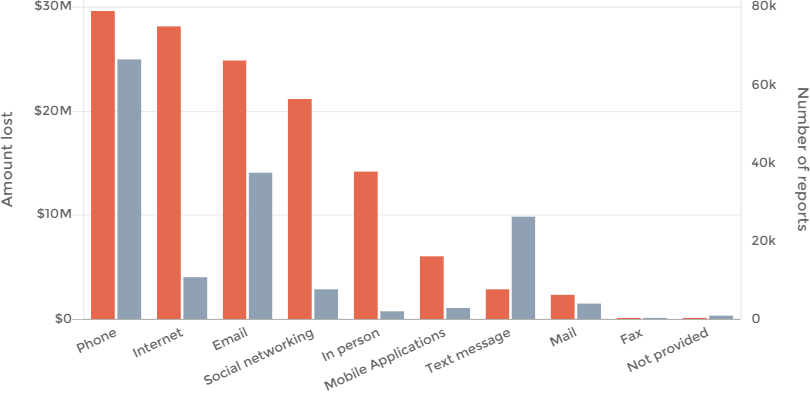
Scam calls for donations might arrive in lots of different ways. This chart shows results for 2019 in Australia (not including the current bushfire disaster information) – but the more common methods might change next month, and they might be different in your area right now because scammers change tactics when people get wary… But regardless of how you receive an invitation to donate, you can use the same basic principles to protect yourself.
SOURCE: https://www.scamwatch.gov.au/about-scamwatch/scam-statistics
- NEVER give out your financial information to cold callers on the phone, or to door-knockers. Door-knockers frequently show fake ID. If they are real, they will understand why you would prefer to donate via the official website.
- Do NOT donate at a hyperlink in any email, text message or social media post.
- DO check your area’s official list of registered charities. (See below)
- Use the hyperlink in the official list to ensure you are using a real charity website instead of a copycat website.
Do NOT rely on the internet to show you the real website at the top of the list. Scammers use a variety of search engine optimization tricks to make copycat websites appear high in browser searches, so clicking the first one you see in search results is not a reliable method of finding a legitimate site.

IMAGE SOURCE: https://www.consumer.ftc.gov/articles/0074-giving-charity
If you want to donate to crowd-funding
Crowd-funding is a good thing because it is quick to set up and can be used for very specific purposes. For example, to raise money for a particular person/family or project.
It is also potentially a bad thing because there’s higher risk of your money not providing the help you want it to. This is because anybody can set up crowd-funding, and there is no central list of which funds are legitimate.
 SOURCE: Pexels.com (a public free-to-use stock photo)
The risk is that any scammer can set up a crowd-funding project, write any blurb they want, and add some stolen photos, etc, to make you think you are helping out someone in need. In reality, the money will be going into the scammer’s bank account.
Therefore, you will need to do more independent checking.
- If the campaign is run by somebody you know, contact your friend (by some different method) to check that the campaign is real. Some scammers set up copycat social media profiles specifically for the purpose of targeting a whole Friends list.
If you have ever received a second Friend request or Follow from one of your friends, it’s most likely that the second one is a copycat scammer’s account.
This is why you need to contact your friend by phone/text, or at least via the social media profile you are sure is real.
If the campaign is NOT run by a personal friend, there are other things you can do to increase confidence about whether the fundraiser is real:
- Search the internet using the title and/or some of the phrases used in the campaign advertisement. Use ” around the phrase to improve your search results.
If any of those results mention ‘scam’ or ‘fake’, the risk is higher. Of course such a post could be made by a troll, so consider the source of that information. Multiple mentions, from different sources, should indicate high risk to you.
- Upload any of the photos used in the fundraiser campaign to the Google Images search bar. If results match a photo with other people’s names, it is likely the photo has been stolen.
You can look more closely at the search results to find out whether the person is just sharing the photo or if they are using it to represent their own identity.
It’s a lot of work to figure out whether a photo was stolen by the fundraiser or from the fundraiser, so this is a good point to give up and donate by some less risky way.
This list of tips is not exhaustive. For more information, I include some USA and Australian government resources…
Where to find more information about Charity Scams
About Fake Charities, generally:
https://www.scamwatch.gov.au/types-of-scams/fake-charities
Australian fake scam statistics, 2019:
https://www.scamwatch.gov.au/about-scamwatch/scam-statistics
Before giving to a charity in the USA:
https://www.consumer.ftc.gov/articles/0074-giving-charity
The Australian Charities and Not-for-profits Commission’s charity register:
https://www.acnc.gov.au/charity
—————————————
Do you have a story about a Charity Scam? Let us know in the Comments.
As always, if you found this information useful or helpful,
please do share it to your social media accounts
to help out your friends and family too.
It’s only by talking about scams, and increasing awareness of all the different ways they can happen, that we will be able to lower the risk of falling victim to them.

 That Scam Show
One thought on “Watch out for Charity Scams”